UV adhesives are a class of adhesives that cure rapidly upon exposure to ultraviolet light. They are widely used in electronics, optics, medical devices, automotive components, and packaging due to their fast curing speed, solvent-free formulation, excellent optical clarity, and strong adhesion to various substrates.
The performance of a UV adhesive depends heavily on its formulation – particularly the choice of 单体s used as reactive diluents. These 单体s not only adjust viscosity for processing but also significantly influence final properties such as adhesion, flexibility, hardness, shrinkage, and resistance.
This article introduces four key monofunctional acrylate 单体s commonly used in UV adhesive formulations – THFA, IBOA, DMAA, and ACMO – along with their modified derivatives.
Tetrahydrofurfuryl Acrylate (THFA,Cas No 2399-48-6) is a colorless to light yellow liquid widely used in UV-curable 涂料, inks, adhesives, and polymer modifications.
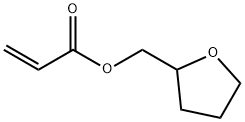
Molecular Formula: C₈H₁₂O₃
Structure: A tetrahydrofuran ring (saturated five-membered oxygen heterocycle) linked to an acrylate double bond via an ester linkage.
Role of the cyclic structure:
Provides flexibility to the polymer chain
Offers good chemical resistance (stable against acids, alkalis, and solvents)
Reduces molecular polarity, improving compatibility with hydrophobic 单体s
An ethoxylated derivative of THFA that offers:
Greater flexibility
Lower skin irritation
Stronger viscosity reduction
Better leveling properties
A methylated version of THFA with an additional methyl group on the alpha position of the acrylate double bond:
Lower shrinkage
Lower irritation
Better yellowing resistance
Higher hardness
| Feature | Description |
|---|---|
| Strong Dilution Power | Industry-recognized top-tier viscosity reducer; outperforms DPGDA, TMPTA, and TPGDA in dilution and dispersion |
| Excellent Compatibility | Miscible with virtually all UV resins – no phase separation, no haze |
| Good Leveling | Produces smooth, defect-free films with minimal pinholes and craters |
| Broad Adhesion | Good adhesion to plastics (PC, PET, PVC), metals, and glass |
| Good Flexibility | Soft films with low internal stress, resistant to cracking |
| Low Odor | Mild sweet/fruity aroma; much milder than HDDA, TPGDA, or TMPTA; very low residual odor after curing |
| Moderate Chemical & Weather Resistance | Best combined with IBOA or alicyclic 单体s for demanding applications |
| Application | Dosage | Function |
|---|---|---|
| UV 涂料 (plastics, wood, films) | 5–20% | Viscosity reduction, leveling, flexibility, adhesion improvement |
| UV inks (screen, flexo, gravure) | 5–15% | Improves transfer, wetting, and adhesion on films |
| UV adhesives (optical, electronic) | 5–25% | Low shrinkage, good flexibility, high transparency |
| 3D printing resins | 10–30% | Strong viscosity reduction, low odor, low irritation |
| UV nail gels | 10–25% | Soft, flexible, good leveling, low irritation |
Isobornyl Acrylate (IBOA) is a bio-based 单体 derived from camphene, a natural product obtained from pine rosin. It offers a renewable carbon content of up to 76%, contributing to green manufacturing and VOC reduction.
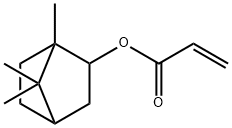
IBOA features a rigid isobornyl ring structure (two fused six-membered rings) connected to a reactive acrylate group.
| Feature | Description |
|---|---|
| High Hardness & Gloss | Produces hard films with excellent optical clarity and premium surface finish |
| Strong Adhesion | Excellent adhesion to PP, PE, metals, glass, and difficult plastics |
| Low Shrinkage | Minimal internal stress – resists warping and cracking |
| Good Dilution Power | Low viscosity, stable viscosity reduction |
| Excellent Water, Weather & Chemical Resistance | Hydrophobic, resistant to boiling water and salt spray |
| Low Irritation | Milder than LA, EMA, suitable for export-oriented formulations |
| High Tg (~97°C) | Enhances thermal stability and mechanical strength |
| High T₂ (Beta Transition) ~58°C | Imparts excellent damping and toughness properties |
| Low Skin Irritation Index (PII ≤ 4.0) | Safe for skin-contact applications |
IBOMA (Isobornyl Methacrylate):
Offers excellent toughness and good weather resistance
Higher Tg (~170°C) with excellent wear resistance
Suitable for applications requiring high heat resistance
| Application | Dosage | Function |
|---|---|---|
| UV plastic 涂料 (ABS, PC, PMMA) | 5–15% | Improves gloss, hardness, adhesion, reduces shrinkage |
| UV metal/glass 涂料 | 5–12% | Enhances adhesion, boiling water resistance, salt spray resistance |
| UV inks (screen, flexo, food packaging) | 3–10% | Strong adhesion to BOPP, PE, PET; low odor |
| UV adhesives (optical, electronic) | 5–20% | Low shrinkage, high transparency, strong bonding |
| 3D printing resins (SLA/DLP) | 10–25% | High hardness, high precision, low odor |
| UV nail gels | 8–20% | High gloss, high hardness, scratch resistance, low irritation |
N,N-Dimethylacrylamide (DMAA) is a monofunctional acrylamide 单体 that provides strong dilution power and excellent compatibility with various UV resins. Its unique structure enables micro-etching and swelling on low-surface-energy substrates including polyolefins, PP, PE, ABS, PC, PMMA, and PET, significantly improving adhesion.
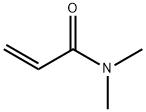
Molecular Formula: C₅H₉NO
Molecular Weight: 99.13 g/mol
Structure: A vinyl group conjugated with a dimethylamide group
Dual functionality:
Double bond (C=C): Provides high reactivity for copolymerization with acrylic 单体s, styrene, vinyl acetate, etc.
Amide group (-CONH-): Provides polarity for compatibility with polar materials, excellent hygroscopicity, dispersibility, and adhesion.
| Feature | Description |
|---|---|
| Low Viscosity | Easy to handle and formulate |
| High Reactivity | Rapid polymerization; suitable for various polymerization techniques |
| Hydrophilic | Water-soluble – suitable for aqueous systems |
| Strong Adhesion | Excellent adhesion to glass, polycarbonate, and most substrates |
| Excellent Compatibility | Soluble in all solvents except n-hexane |
| Hygroscopic & Anti-static | Suitable for anti-fog 涂料 |
| Application | Description |
|---|---|
| UV/EB curing 涂料 & inks | Low viscosity, high reactivity – ideal for UV adhesives, 涂料, printing inks |
| Optical materials | High transparency, low shrinkage – used for lenses and optical films |
| Oil & gas | Drilling fluid 助剂 – enhances temperature and salt resistance |
| Healthcare | Medical hydrogels – wound dressings, contact lenses |
| Industrial chemicals | Paper strength agents, water treatment flocculants, textile finishing agents |
| Fiber modification | Improves hygroscopicity, dyeability, and handle of acrylic, polyester, polyamide fibers |
| Plastic modification | Enhances mechanical strength, printability, dyeability, anti-static properties, and glass fiber affinity |
Acryloyl Morpholine (ACMO) is a monofunctional acrylamide 单体 with very low skin irritation and low odor. Its structure combines a hydrophilic morpholine group and a hydrophobic carbon chain.
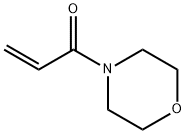
Dual functionality:
Acrylate group: Drives rapid UV/EB polymerization
Morpholine ring: A six-membered heterocycle containing nitrogen and oxygen, providing:
Low viscosity – excellent reactive diluent
Excellent pigment wetting & dispersion – ensures uniform color and better coating appearance
Enhanced adhesion – through polar interactions
Improved flexibility & impact resistance
| Feature | Description |
|---|---|
| Good Dilution Power | Effectively reduces system viscosity |
| Excellent Compatibility | Acts as a compatibilizer (amphiphilic 单体), miscible with most oligomers and 单体s |
| Good Pigment Dispersion | Excellent dispersion stability for organic and inorganic particles |
| Low Odor & Irritation | Milder than most monofunctional 单体s |
| Fast Curing Speed | Reduced oxygen inhibition; comparable to multifunctional 单体s |
| Good Chemical Stability | Resistant to acids, alkalis, and hydrolysis |
| Good Heat Resistance | Suitable for high-temperature applications |
| Low Curing Shrinkage | Excellent dimensional stability |
| Good Toughness | Balanced hardness and flexibility |
| Application | Description |
|---|---|
| UV 涂料, inks & adhesives | Reactive diluent – reduces viscosity, improves curing efficiency, adhesion, abrasion resistance, and heat resistance |
| Medical hydrogels | Wound dressings, contact lenses – due to hydrophilic and low-irritation properties |
| Electronics | Electronic adhesives, display panel manufacturing – improves adhesion and optical properties |
| Electronic encapsulation | Epoxy modification – improves dielectric properties for high-frequency circuit boards |
| Oil drilling | Drilling fluids and cementing materials – enhances heat resistance, salt resistance, and lubricity |
| Textile 涂料 | Imparts water resistance and abrasion resistance |
| Photoresists | Improves resolution and development performance in semiconductor lithography |
| Hair styling products | Enhances flexibility and humidity resistance |
| Thickeners | Rheology modifier in cosmetic emulsions and gels |
| Feature | THFA | IBOA | DMAA | ACMO |
|---|---|---|---|---|
| Functionality | Monofunctional | Monofunctional | Monofunctional | Monofunctional |
| Key Advantage | Dilution power & flexibility | Hardness & adhesion | Broad adhesion & compatibility | Low irritation & fast cure |
| Odor | Low (sweet/fruity) | Very low | Moderate | Very low |
| Shrinkage | Low | Very low | Moderate | Low |
| Adhesion | Good | Excellent (also to PP/PE) | Excellent | Good |
| Water Resistance | Moderate | Excellent | Moderate | Good |
| Typical Use | General purpose | Hard, durable 涂料 | Adhesion promoters, hydrogels | Low-irritation adhesives & inks |
A: DMAA provides the broadest adhesion to most plastics, including PP, PE, ABS, PC, PET, and PMMA, due to its ability to micro-etch and swell polymer surfaces. IBOA is particularly effective on PP, PE, and metal substrates.
A: THFA is an acrylate (–CH₂=CH–COO–), while THFMA is a methacrylate (–CH₂=C(CH₃)–COO–). THFMA offers lower shrinkage, lower skin irritation, better yellowing resistance, and higher hardness, making it suitable for applications requiring superior durability and low color change.
A: IBOA provides a high glass transition temperature (Tg ≈ 97°C), which ensures excellent thermal stability, dimensional stability, and mechanical strength at elevated temperatures.
A: DMAA is highly reactive and may require specific regulatory clearance for food contact. It is primarily used in industrial applications. For food-grade formulations, always check compliance with local regulations.
A: ACMO offers very low skin irritation and low odor compared to most other monofunctional 单体s. Its hydrophilic morpholine structure also provides good biocompatibility, making it suitable for medical hydrogels, wound dressings, and UV nail gels.
A: THFA and ACMO are both known for low odor. THFA has a mild sweet/fruity aroma and is significantly less pungent than HDDA or TMPTA. ACMO is also very low odor and low irritation.
A: Yes. These 单体s are highly compatible with most UV resins and with each other. They are often combined to balance viscosity, adhesion, hardness, flexibility, and cure speed. For example, THFA + IBOA is a common combination for plastic 涂料.
A: Typical dosage ranges are 5–30% depending on the application. Specific recommendations are provided in the application tables above. For new formulations, start with lower dosages and adjust based on performance testing.
中固化学集团
No. 61, South Industrial Road, Jinan Area of Shandong Pilot Free Trade Zone, China
Email: Info@sinocurechem.com |Tel: +86 15668330235
Website: www.sinocurechem.com
This document is for informational purposes only. Users should conduct their own testing to determine suitability for their specific applications. SINOMER® is a registered trademark of 中固化学集团.


